



















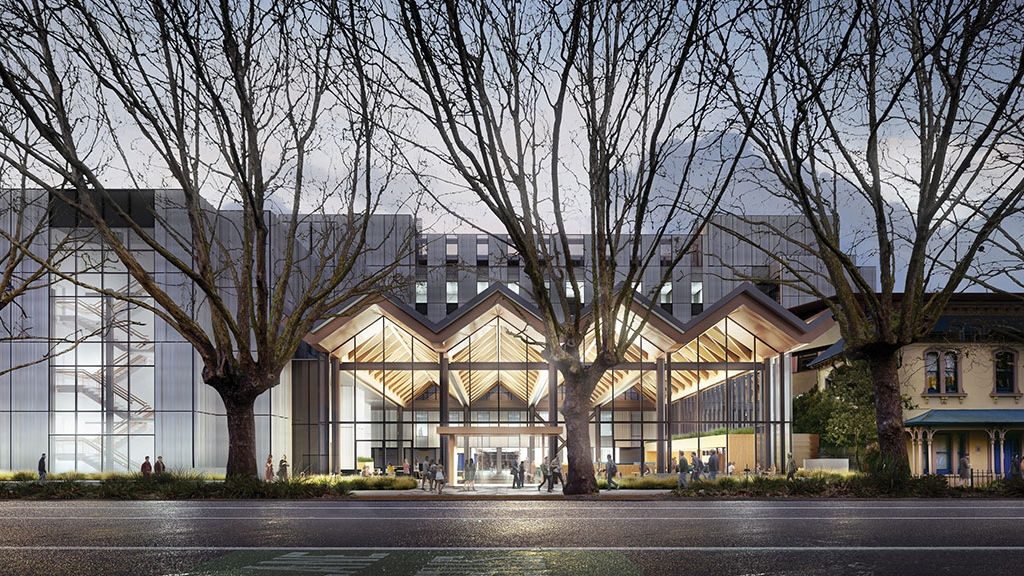


The University of Auckland’s B201 building represents a leading example of adaptive reuse and world-class low carbon design in New Zealand. The refurbishment of this 50-year-old building into a state-of-the-art academic facility reflects the University’s commitment to sustainability and environmental responsibility. Originally planned for demolition, the building has been transformed into a modern space for the Faculty of Education and Social Work, Faculty of Arts, and Faculty of Creative Arts and Industries. The project has also become one of Aotearoa New Zealand’s most sustainable developments.
| Funding Programme | Infrastructure Reference Group |
| Project Owner | University of Auckland |
| Infrastructure Type | Education |
| IRG Funding | $200million(concessionary finance) |
| Co-funding | $75 million (Auckland University) |
| Total Project Cost | $275 million |
| Project Completed | October 2023 |
Design and Sustainable Features
B201 has been awarded 6 Green Stars for design by the New Zealand Green Building Council (NZGBC), receiving the highest score to date – 93 out of 100 points. The design of B201 is a testament to sustainable practices, achieving half the embodied carbon and only a third of the energy required by a new equivalent building. The project has also met the LETI (Low Energy Transformation Initiative) 2030 design target of 300kg CO₂/m² for upfront carbon emissions, with a recorded performance of 250kg CO₂e/m².
Key sustainable design features include:
- Adaptive reuse of the original structure, which reduced the construction timeline by one year and resulted in 25% cost savings compared to full demolition and new build.
- Replacement of the original heavy concrete cladding with lightweight, high-performance curtain walling made from recycled aluminium, which reduced the load on the existing structure and extended its life for another 50 years.
- Thermally efficient cladding to minimise heat gain, combined with optimal glazing-to-wall ratios and high-performance glass to further improve energy efficiency.
- Adoption of passive house air-tightness design principles and an ‘ultra-low energy’ mechanical ventilation system, contributing to the building’s impressive energy performance.
Cultural Integration
A significant aspect of the B201 design is its consultation with Ngāti Whātua Ōrākei, whose cultural narratives were woven into the building’s design. The design honours the rich history of the site, which lies above the historic Waipapa village and Te Tōangaroa foreshore, a significant location for waka landing, the exchange of sustenance, knowledge, and culture.
Impact on the University and Community
The refurbished B201 building will accommodate 3,000 to 4,000 staff and students, providing a modern academic environment for the University’s Faculty of Education and Social Work, Faculty of Arts, and Faculty of Creative Arts and Industries. The building will serve as a hub for research, learning, and social interaction, providing a healthy, accessible, and comfortable space for all its occupants.